On this page
- Choosing Your Path: Knife Making vs. Bladesmithing
- Finding the Right Anvil
- Forges and Heat Sources
- The Versatile Hand Grinder
- Files and Hand Tools
- Hammers for Moving Metal
- Clamping Down: Choosing a Vise
- The Drill Press
- A Budget-Friendly Heat Treat Setup
- Belt Grinders and Sanders
- Abrasives and Sandpaper
- Shop Safety and PPE
- Final Thoughts Before You Light the Forge
Lately, my inbox has been flooded with a ton of questions from viewers and readers. While a few jokers have asked about my personal hygiene, the vast majority of you are asking the same thing: how do you get into knife-making or bladesmithing?
It is incredibly exciting to see so many people taking an interest in this ancient craft, but I completely understand the hesitation. You are interested in the craft, but you simply do not know where to start. You look at a fully equipped shop and wonder how you could ever afford all of that gear. That is exactly why I decided to create this brand new Bladesmithing 101 series.
This series is designed specifically for the new person who really does not know very much, does not have the tools, and does not know where to go. I am going to break down every single section of knife-making to help you get your footing. This very first installment is all about the gear. We are going to discuss which essential tools you need, which you might want down the line, and where you can get them without emptying your wallet.
Choosing a Path: Knife Making vs. Bladesmithing
Before you start shopping, you have to ask yourself a fundamental question. You might not know the absolute answer right now, since you are new, but it will dictate the tools you buy. Do you want to forge blades, or cut them out using a process we call stock removal?
There is a massive difference between the two approaches. If you are exclusively cutting out profiles from flat bar stock and grinding in the bevels, you are technically a knife maker. If you are taking a glowing-hot piece of steel and physically hammering it into a blade, then you are a bladesmith. I want to be clear that neither method is better than the other, but they require entirely different tools for different jobs.
You will have to decide which route calls to you. As for me, I am a bladesmith. I prefer to forge out my blades to shape. To do that properly, I absolutely need an anvil. But here is the secret: it does not even have to be a traditional anvil. It really just needs to be a heavy, hard piece of steel.
Finding the Right Anvil
Ever since shows like Forged in Fire hit the airwaves, everybody and their brother wanted to become a bladesmith. People started buying up anvils left and right. Suddenly, a rusted block of iron that was sitting neglected in a barn for a hundred years is now worth thousands of dollars. That being said, you do not have to fall into that trap. There are several economical ways to tackle this.
I actually found my main anvil in an antique store, and it dates back to 1880. It is far from perfect. The horn has been completely snapped off, and frankly, it looks like it was dragged behind a tank. But the face is hard, it still works beautifully, and I picked it up for around two hundred and fifty bucks. It still has the hardy hole for my bottom tooling and the pritchel hole for punching, which is most of what I need.
When I very first started out, a good friend of mine actually made me a starter anvil. He simply shaped it out of a heavy piece of railroad track. You can easily find pieces of track at scrap yards or online. There are also several new manufacturers starting to make budget-friendly anvils. I believe Harbor Freight offers a cast iron one, and brands like Vevor have some economical steel options.
The key takeaway here is that if you are just getting started, you absolutely do not have to break the bank. Do not go out and drop a thousand dollars on a premium anvil right away. Get yourself a thick piece of railroad track, have somebody cut it flat for you, and start there. It will suffice for now, giving you something hard to shape the blade and forge it.
Forges and Heat Sources
The next essential piece of equipment we need to look at is your forge, or your main heat source. If you are going to be a bladesmith, you must have a forge — there is simply no way around it. You need a reliable way to get your steel to critical temperature so you can forge it and move the material.
In my shop, my primary workhorses are two Majestic forges that run on propane gas. I do actually own a coal forge that I built myself, but it is currently buried in a corner somewhere, which should tell you exactly how much I use it. Gas forges are just incredibly efficient.
If you look inside my gas forges in some of my other videos, you will see a massive heating area. This gives me a nice, uniform, beautiful heat across the entire blade. They heat up incredibly fast, and I can easily reach forge-welding temperatures without much effort.
Conversely, a coal forge takes a long time to get heated up and requires constant maintenance while you work. You have to keep a close eye on the fire the entire time. The actual sweet spot for heat is not very big in a coal forge. Because of that, you often do not get uniform heat across the entire blade, which makes long knives difficult. Plus, you always run the very real risk of leaving your steel in too long and literally burning it up like a sparkler.
My Majestic forges are made locally right here in Ohio, and they are the exact same brand used on Forged in Fire. But lately, the market has exploded with manufacturers producing affordable gas forges. You can hop on Amazon, look up Vevor, and purchase a complete setup for a very reasonable price. You are only going to spend a couple of hundred dollars, and if you want to swing a hammer, this tool is mandatory.
I often get asked if you can build your own gas forge. You certainly can, but unless you possess a solid understanding of exactly what you are doing, I highly suggest you do not attempt it. Building a safe forge requires sourcing specific ceramic wool insulation and heat-resistant refractory cement to line the interior. You also have to precisely calculate and tune your air-to-fuel mixture for the burners. Honestly, considering you can buy a brand new, professionally built gas forge for a couple of hundred bucks, I do not see the reason to risk building one yourself. You can also constantly see lightly used setups popping up on Facebook Marketplace.
The forge is not just for shaping metal, either. When you are knife-making, you absolutely have to heat-treat your steel if you want it to hold an edge. Unless you plan to send your blades to a professional service or you own a dedicated heat-treat oven, the forge is your only option. If you are just starting out, you definitely won't have a specialized digital oven, so your gas forge is the method you will have to use to harden and temper your knives.
Heat treating is arguably the single most critical step in making a good knife. Depending on the exact steel alloy you choose, the heat-treat process can be either very forgiving or incredibly strict. We will dive deep into steel choices in another video, but for beginners, heat treating in a simple forge is completely doable. Eventually, as you progress, you will want to move up to a digital oven that is much more exact.
You can buy forges in various sizes. I run a three-burner and a two-burner. You can buy massive five or six-burner forges where the sky is the limit. But my honest suggestion for a beginner is to start out with a simple two-burner model. Even if you are strictly doing stock-removal knife-making, you will still need a forge for in-house heat-treating, so keep that in mind.
The Versatile Hand Grinder
Now let's move on to power tools. There is one specific tool I bought when I first started that I still use every single day in the shop: the handheld angle grinder.
Angle grinders are remarkably versatile tools. I use them to aggressively cut thick steel bar stock down to size. You can attach many different kinds of wheels to accomplish very different jobs. I use thin cutoff wheels for slicing. I highly recommend picking up a flat flap disc wheel — it lets you quickly smooth out your work and hog off material, which is a lifesaver if you do not yet own a belt grinder.
There are grinding stones, sanding pads, and even heavy wire wheels for stripping scale and rust. If you are just getting started in bladesmithing, I highly recommend picking up a hand grinder immediately. You can find these at all price points. A basic corded grinder from Home Depot will not break the bank, and you can always check Marketplace for used deals.
I cannot stress enough how handy an angle grinder is. If you are doing stock removal, you can practically profile a whole knife with one. Even if you are forging, you still have to clean up the profile, grind off the nasty forge scale, and roughly put your bevels in. An angle grinder will easily suit your initial needs.
Files and Hand Tools
Next up on the essential tools list: files. Files, files, and more files. You are honestly never going to have enough files in your shop, especially during those early days. When you do not have the luxury of expensive belt grinders, you will rely entirely on hand files to remove steel.
You will use them to meticulously file in your blade bevels. You will use them to contour tricky areas, clean up rough spots, and fit metal guards if you decide to make hidden tang knives. You even need wood rasps and files to shape your handle materials. You are guaranteed to end up with a large collection.
When it comes to purchasing files, my golden rule is that you get exactly what you pay for. I strongly recommend avoiding the cheap, generic files found in lower-end discount stores. Cheap files simply do not have the proper hardness to bite into high-carbon steel. They will wear out incredibly quickly, the teeth will snap off, and you will get frustrated fast.
This is especially true when you get into tiny precision needle files. Do yourself a favor, pony up the cash, and invest in reputable, high-quality files. You absolutely need files with a hardness high enough to effortlessly cut through unhardened blade steel.
Hammers for Moving Metal
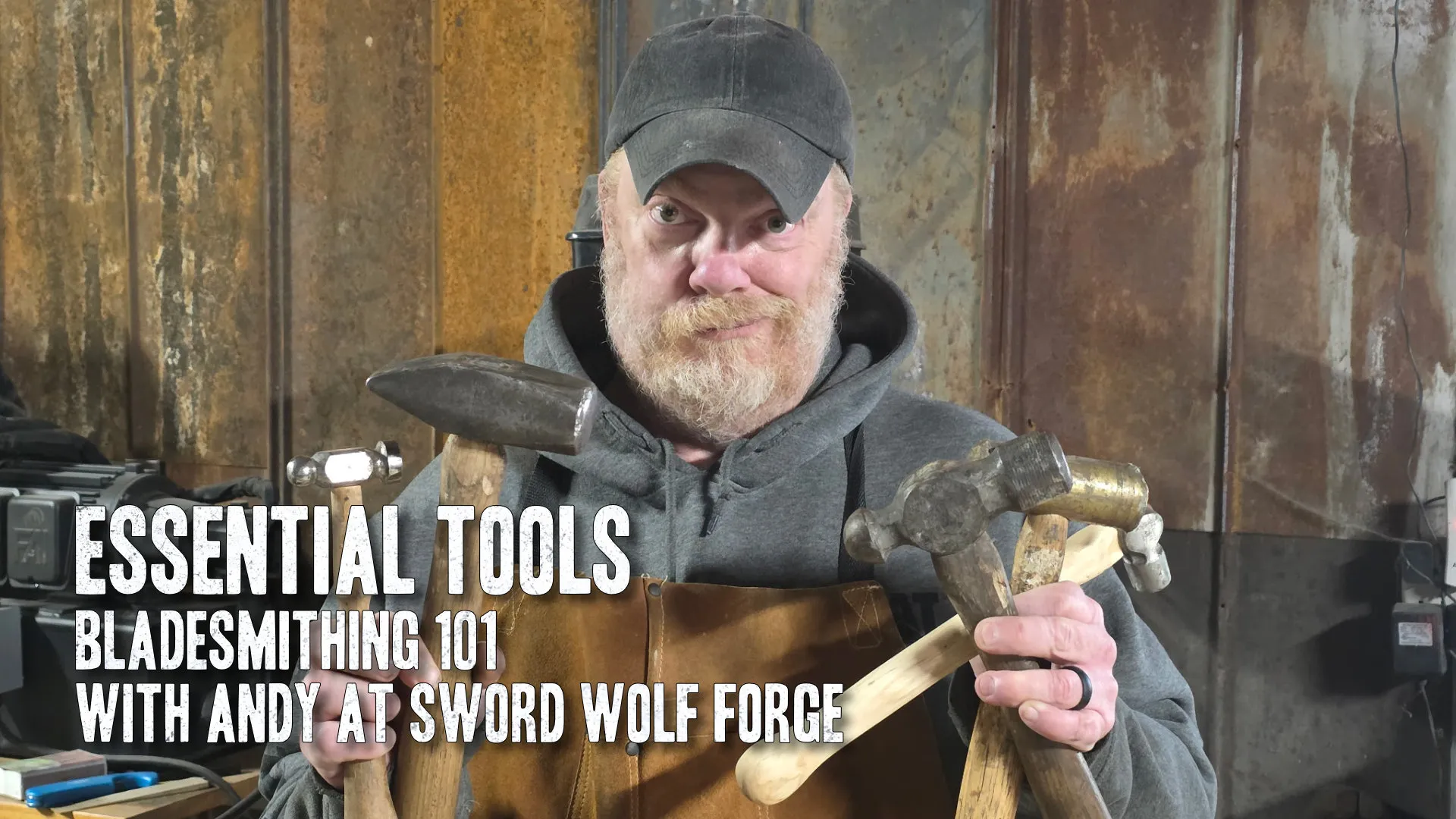
As you might have guessed by the name, Bladesmithing 101, you are going to need hammers to hit hot steel. My rack holds a massive collection, but when you are starting, you absolutely do not need all of these. Hammers can widely vary in price, and specialized custom forging hammers can easily run a couple of hundred bucks.
However, my first real forging hammer was purchased from Harbor Freight for under thirty dollars. It is a simple three-pound hammer, and I used it extensively for my first couple of years. I took my angle grinder and carefully cleaned up the sharp edges on the face, and it served me incredibly well.
As your skills progress, you will naturally want to start acquiring a diverse collection of hammers. The main hammer that I swing every single day is a simple three-pound cross peen. I have the distinct luxury of living near Amish country, so I take a drive up there and buy fantastic hand-forged hammers for no more than thirty bucks.
If I could recommend only one hammer to acquire first, it would be a three-pound cross peen. The peen is the wedge-shaped back of the hammer head. They come in all sizes and shapes, but it is the absolute go-to tool. The narrow peen acts like a blunt chisel, aggressively displacing the hot steel in one direction, making it perfect for drawing out the length of a blade.
If you are hunting for a used hammer at a flea market, pay close attention to the shape and condition of the wooden handle. Replacement handles are cheap, but hanging a new handle perfectly can be a real pain. Most importantly, carefully inspect the striking face. Are there any big gouges, chipped chunks, or deep cracks?
Every flaw on your hammer face will transfer directly into your hot steel. If there is a massive deformation on the hammer, it will leave an ugly scar in your blade. You want a smooth, slightly crowned face. If a used hammer has minor dings, you can easily clean it up with a flap disc on your grinder. Keep an eye on your hammer faces while you work, too — sometimes you strike a cold edge and create a sharp burr of steel on the hammer face, and you need to file that smooth immediately.
My overall rule of thumb is that I am not a cheapskate, but I completely refuse to spend a whole bunch of money on a premium tool when I can buy or modify something for thirty bucks that does the exact same job. Check Marketplace, dig through garage sales, and hunt for barn finds. Start slow, grab that cross peen, and build up over time.
Clamping Down: Choosing a Vise
To actually work on your knives comfortably, you will need vises to securely hold your blades. I use a vise every single day in the shop to file bevels, sand handles, and straighten warps.
For a beginner, just get yourself a basic cast-iron machinist's vise from Harbor Freight. You can mount it directly to your workbench, and it is perfect for holding material while drilling or doing detail work.
If you are doing heavy forging, the ultimate goal is to find a traditional blacksmith post vise, also known as a leg vise. Prices on these skyrocketed a few years ago, but they are finally starting to come back down. You can usually find a reasonable, restorable one for under two hundred dollars.
A leg vise bolts securely to your workbench, but it features a long steel leg that rests solidly on the floor. That leg transmits all the heavy shock energy directly into the ground. Because of this design, you can take a heavy hammer and beat mercilessly on steel clamped in the jaws without shattering the cast iron — which would instantly destroy a normal machinist vise.
I see them all the time on Marketplace and sitting in dusty antique stores. When inspecting a used leg vise, look closely at the jaws. Make sure they line up nicely and are not heavily damaged. Also, check the massive leaf spring that pushes the jaws open; make sure it is physically there and free of deep cracks.
When holding delicate knife blades in any vise, make sure to line the rough steel jaws with soft pieces of scrap leather or wood so you do not gouge your work. Do not stress if you cannot find a leg vise immediately. A basic bench vise will get you through your first several knives just fine.
The Drill Press
Another power tool you will heavily rely on is a drill press. When making a full tang knife, you must drill perfectly straight holes through the steel tang to insert your handle pins. If you are making a hidden tang, you have to precisely hollow out a deep cavity in your block of wood. You can theoretically attempt this with a cordless hand drill, but I highly advise against it.
The beauty of a drill press is that the spindle lowers perfectly straight down. You are not going to accidentally drill at an awkward angle. This is vital because if your pin holes are drilled crooked, your handle scales will never sit flush against the steel.
A drill press also saves you from the infamous "propeller of death." Sometimes when drilling through steel, the bit violently catches the metal. If you are holding the blade by hand, the drill press will rip the knife from your grip and start spinning a razor-sharp piece of steel at high speed. It is terrifying. Always securely clamp your work to the drill press table.
You do not need a massive, thousand-dollar industrial floor model. The basic table-mounted drill presses from Harbor Freight or used options on Marketplace are completely fine for knife making. Just bolt it to a sturdy stand, invest in some high-quality cobalt or high-speed steel drill bits, and you are in business.
A Budget-Friendly Heat Treat Setup
Earlier, I mentioned that heat treating in a gas forge can be slightly uneven. Down the road in our build series, we are going to fully dedicate a whole video to mastering the heat-treat process. But I do not want you to get halfway through your first knife build and realize you are missing crucial gear.
To heat-treat effectively in a gas forge, you need an economical way to monitor and equalize temperature. Head to a metal supplier and buy a heavy piece of square steel tubing, often called a muffle pipe. You stick this piece of steel tubing directly into the raging forge fire.
Instead of thrusting your delicate blade right into the direct flame, you place the knife inside the steel tubing. The thick steel tube absorbs the direct blast of the burners and radiates a soft, beautifully even heat around your knife. It effectively turns your forge into a miniature oven.
To monitor the temperature, purchase an affordable Type K thermocouple thermometer and a high-heat thermal probe from Amazon. You slide the ceramic probe into the steel tube right next to your blade. This setup allows you to read the exact ambient temperature right where your knife is sitting, eliminating the dangerous hot and cold spots that cause warping. It might cost you fifty bucks to set up, but it dramatically improves your success rate until you can afford a digital kiln.
Belt Grinders and Sanders
Let's talk about the tool everyone dreams of: belt grinders. Grinders are not strictly a must-have to make a knife, but I will be brutally honest — if you are going to pursue this hobby, you are going to want one. I have seen guys meticulously file in beautiful bevels by hand, but that extreme level of time-consuming physical labor does not interest me whatsoever.
My very first sander was a cheap 4x36 woodworking sander. It is basically just one tiny step above hand-filing. The giant motor gets in the way, making it completely impossible to grind clean plunge lines. It is decent for flattening handle materials on the side disc, but I really would not bother going down this frustrating path for grinding steel.
I quickly saved up and upgraded to a Grizzly 2x72 knife maker's grinder. I made a lot of knives on that machine for over ten years. It cost roughly seven hundred dollars. The downside is that it has only one incredibly fast speed and runs in only one direction, making delicate finishing work terrifying.
Today's beginner market is much better. You can pick up a small 1x30 or 2x42 belt grinder from Harbor Freight for under a hundred bucks. These machines are fantastic entry points. The abrasive belts are cheap, and they allow you to safely learn the steep learning curve of machine grinding without risking serious money.
I eventually progressed to my current crown jewel, a variable-speed Ameribrade 2x72. I absolutely love this machine, but I would never recommend a beginner drop thousands of dollars on one until they know for sure they love the craft. Start small, learn the mechanics, and hunt for a used Grizzly or similar machine on Marketplace when you are ready. Keep in mind that quality abrasive belts are serious consumables — they burn out quickly, and replacing them at ten to thirty bucks a pop adds up fast.
Abrasives and Sandpaper
Speaking of abrasives, you will need a mountain of sandpaper. Whether you forge or grind, the final finish is always done by hand.
You need a progression of grits, typically starting at 220, then moving to 400, 600, 800, and sometimes up to 2000 grit for mirror-polished finishes on high-end Damascus. You absolutely cannot skip grits. You must use 220 to remove the grinder scratches, then 400 to remove the scratches left by 220, and so on.
Premium automotive wet/dry paper cuts faster and lasts longer but is very expensive. When you are just starting, head down to Ace Hardware and buy a basic assortment of wet/dry paper. As you improve, you can invest in bulk rolls of premium abrasives. You will also want to make or buy hard backing blocks to wrap your sandpaper around, which keeps your flats crisp and your grind lines sharp. Expect to dedicate a whole drawer in your shop just to abrasives.
Shop Safety and PPE
Finally, we must discuss the most critical topic: safety and personal protective equipment. The most important tool in your entire shop is your own body, and you must protect it fiercely. For employer-style baseline expectations on PPE selection and use, OSHA’s personal protective equipment overview is a useful reference (adapt what applies to your home shop).
When I host classes, the very first thing I do is physically walk the students around the shop and point out the safety gear. I explicitly warn them that every single machine in this room is mindlessly trying to kill or maim them. This equipment does not care about your fingers.
When forging, I always wear a heavy leather apron to deflect flying scale. I suggest acquiring thick, heat-resistant leather gloves. Be warned: do not buy cheap synthetic gloves. I once wore the wrong gloves, grabbed hot steel, and the synthetic material literally melted, wrapping around my flesh. It was a nightmare to rip off.
Every shop must have a mounted fire extinguisher and a heavy fire blanket. You absolutely need a fully stocked first aid kit. Make sure you frequently replenish the bandages and check the expiration dates on burn creams. Bleeding on your project while hunting for a Band-Aid is the worst feeling.
Eye protection is non-negotiable. I have had a shard of steel embedded in my eyeball. Let me promise you, lying perfectly still while a doctor digs metal out of your conscious eye is an experience you want to avoid at all costs. Wear wrap-around safety glasses when grinding, forging, or cutting.
You must also protect your lungs. Inhaling airborne steel dust, fiberglass handle material, or exotic wood dust will cause severe, irreversible lung damage. Tragically, a bladesmithing friend of mine passed away from lung cancer, and the fine dust in our shops is a known hazard. Invest in a high-quality half-face respirator with P100 particulate filters. Even heavy-duty N95 masks do a decent job, but a dedicated respirator is far superior.
Lastly, wear thick leather boots. When you forge, glowing hot chunks of slag constantly fall to the floor. I foolishly wore thin sneakers once, a piece of molten steel burned right through the top, and by the time I frantically ripped the shoe off, the damage was already done. Dress for the environment.
Final Thoughts Before You Light the Forge
I know we just covered a massive amount of information and an intimidating list of tools, but please do not get overwhelmed. You do not have to purchase everything on this list today. Start slow. If you have a neighbor with a drill press, politely ask to borrow it. Seek out local bladesmithing groups — the Artist-Blacksmith's Association of North America (ABANA) is a good place to find affiliates, conferences, and education — and attend their weekend hammer-in events. You can test out their anvils and grinders to see what you actually like before spending a dime.
Remember, if I can learn how to do this in my garage, you absolutely can too. It just takes a little patience and time. I skipped over sharpening supplies entirely because that process is complex enough to deserve its own dedicated video later in this series.
In our very next Bladesmithing 101 video, we are going to dive deep into blade steels. We will discuss how to choose the right beginner steel, which alloys to completely avoid, and the science behind heat treatment. You definitely do not want to miss that one. Start with The Best Steels for New Bladesmiths, then continue to Planning Can Save Your Steel.
If you have any questions about the gear we covered, reach out through the contact form and I will point you in the right direction. If you think I missed a crucial starter tool, tell me what you use in your shop.
To keep up with the whole series and see these tools in action, be sure to head over and subscribe to our YouTube channel.